Why the Sleeve Decides Whether You Actually Wear a Swim Cover-Up
Quick Answer: A cover-up sleeve fails when the fabric grips wet skin and the opening is too narrow to pull over a damp arm, which is the moment most cover-ups get abandoned. The sleeve needs a generous armhole, a wide enough opening at the hem of the sleeve, and a fabric that slides rather than clings. Loose flowing sleeves in a smooth-surfaced fabric work; fitted sleeves in cotton jersey or crinkle textures do not. This is a separate problem from the fit issues covered by the armhole itself.
You get out of the pool, reach for the cover-up, and spend a genuinely undignified thirty seconds fighting a sleeve that has stopped halfway up your forearm.
This blog has covered why the armhole decides comfort and why cover-ups cling differently once wet. The sleeve is the related and separate failure, and it is the reason a lot of cover-ups end up staying in the bag.

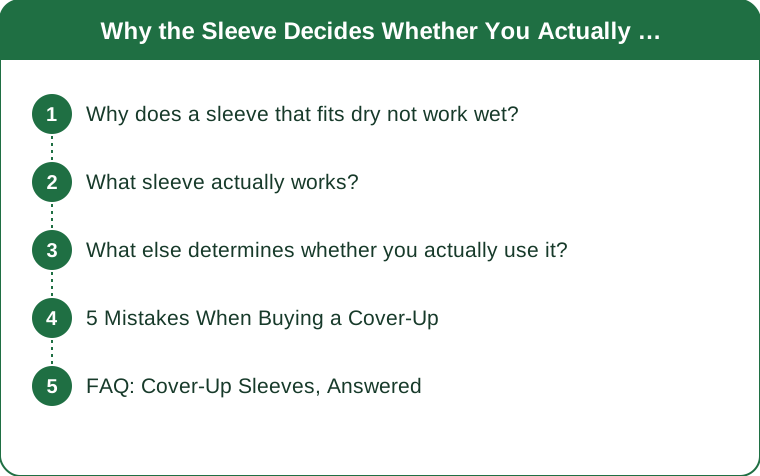
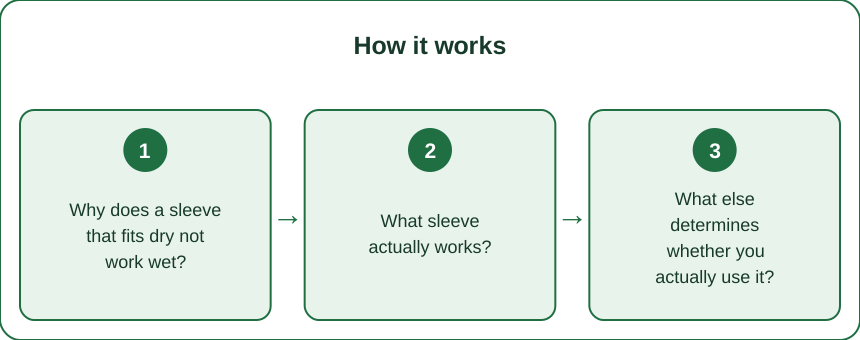
Why does a sleeve that fits dry not work wet?
Because wet skin creates friction rather than reducing it, which is the opposite of what people expect.
Water between two surfaces can act as an adhesive, not a lubricant. At the thin film level, water creates surface tension between skin and fabric that resists sliding. This is the same reason a wet swimsuit is far harder to pull on than a dry one.
Absorbent fabrics grab immediately. Cotton and cotton jersey absorb water on contact with wet skin, and a wet absorbent fabric against wet skin has enormous friction. The sleeve stops moving at the point where it first touches damp skin, usually the forearm.
Textured fabrics catch. Crinkle cotton, waffle textures, and heavily woven surfaces have raised areas that grip. They are popular for cover-ups because they look relaxed and hide creasing, and they are among the worst performers wet.
And the arm changes shape when you reach. Pulling a sleeve on involves flexing, which increases the circumference of the forearm and upper arm considerably. A sleeve sized to a relaxed arm is undersized for the act of putting it on.
Which is why the failure point is so consistent. It happens on the forearm, on the way in, at the exact moment you are cold, wet, and in public. The garment may fit perfectly once it is on, which is why people keep the cover-up and keep not wearing it.
What sleeve actually works?
Three properties, and all three need to be right.
A generous armhole. This blog has written about the armhole in detail, and it is the foundation. A tight armhole means the whole sleeve has to be forced through a narrow opening before it can travel down the arm.
A wide sleeve opening at the hem. The sleeve opening should be substantially wider than your relaxed forearm, because you need clearance for a flexed arm and wet skin. A fitted cuff is the single most common failure, and elasticated cuffs are worse than open ones.
A fabric that slides. In rough order of performance:
- Smooth woven viscose, rayon, or a light poly blend. Slide well, dry quickly, and are the most reliable choice for pulling on wet.
- Lightweight smooth linen blends. Good, though pure linen with a coarse weave can catch.
- Smooth-finish cotton voile or lawn. Acceptable.
- Cotton jersey and terry. Poor. Absorbent, high friction, and they hold water.
- Crinkle, waffle, and heavy texture. Poor for the same reason plus surface grip.
Sleeve styles that work well: flutter sleeves, wide kimono sleeves, dolman sleeves, and anything cut generously from the shoulder. All of these have very wide openings and no cuff.
Sleeve styles that fail: fitted long sleeves, anything with an elasticated or buttoned cuff, tight three-quarter sleeves, and raglan cuts with a narrow finish.
And the sleeveless option is legitimate. If the sleeve is the barrier, a cover-up with no sleeve solves it entirely, and the armhole then becomes the only variable. Many people find this is simply the right answer.

What else determines whether you actually use it?
The things that come after the sleeve, which people also do not check in a fitting room.
How it goes on matters as much as the sleeve. An open-front cover-up, a kimono, a shirt, or a wrap goes on like a jacket and never has to travel over your head or over wet shoulders. A pullover cover-up has to clear the head, the shoulders, and both arms while wet. For pure ease of use, open-front designs win by a wide margin.
Length interacts with wet cling. A longer cover-up has more fabric contacting wet skin, so it clings more, which this blog has covered separately. A mid-length open-front piece has both less contact and an easier entry.
Drying time decides whether you wear it twice. A cover-up that absorbs water from your swimsuit stays damp all day. Fast-drying smooth synthetics and viscose blends are considerably more practical than cotton for anything you will put on immediately after swimming.
Indoor pools have different requirements than beaches. This blog has covered the fabric difference. For an indoor pool, where you go from water to changing room in a warm humid environment, ease of putting it on wet is essentially the only thing that matters. At a beach, where you often dry off first, more fabric options work.
Chlorine degrades elastic over time, and any elasticated cuff or armhole will get tighter and less forgiving as the elastic loses recovery. A cover-up that worked in June can be a genuine struggle by September, which is worth knowing before assuming your size changed.
Seasonal note: as the weather turns and outdoor swimming moves indoors, the cover-up requirement changes from sun protection to getting warm and covered fast in a humid room. The fabric and the sleeve that worked all summer may be exactly wrong for that, and this blog has covered why cover-ups stop working when the weather turns.
5 Mistakes When Buying a Cover-Up
1. Trying it on dry, over dry skin, in a warm changing room. This is the only test most people do and it is the one condition the garment will never be used in. Nothing in a fitting room tells you how it behaves over a wet arm.
2. Buying for the neckline and the length. Both matter, and neither determines whether you can get it on. This blog has covered necklines mattering more than length, and the sleeve sits above both in the order of practical importance.
3. Choosing texture for the look. Crinkle and waffle finishes look relaxed and hold shape well and they grip wet skin badly. It is a direct trade-off between how it looks on a hanger and how it functions.
4. Assuming a bigger size solves it. Sizing up increases the sleeve opening slightly and also makes the whole garment longer and heavier, which increases cling. If the sleeve is the problem, change the sleeve style rather than the size.
5. Ignoring how it goes on. A pullover has to clear your head and both arms wet. An open front does not. This single structural difference matters more than any fabric choice, and it is free to prioritise.
The one test worth doing: in the fitting room, flex your arm hard and push the sleeve up to your elbow and back down. If it is a struggle dry, it will be impossible wet.
FAQ: Cover-Up Sleeves, Answered
Why can I not get my cover-up on over a wet arm?
Water between skin and fabric creates friction rather than reducing it, and absorbent or textured fabrics grip immediately. A sleeve sized for a relaxed dry arm is undersized for a flexed wet one.
What fabric is best for a swim cover-up?
Smooth woven viscose, rayon, or a light poly blend. They slide over wet skin and dry quickly. Cotton jersey, terry, waffle, and crinkle textures are the worst performers because they absorb water and grip.
Are open-front cover-ups better than pullovers?
For ease of use, considerably. An open front goes on like a jacket and never has to travel over your head or wet shoulders. If putting it on has been the barrier, this structural change solves most of it.
Why does my cover-up feel tighter than it did in summer?
Chlorine degrades elastic over time, so elasticated cuffs and armholes lose recovery and get tighter across a season. It is usually the garment that changed rather than you.
TL;DR:
- Water between skin and fabric increases friction, so a sleeve that fits dry can be impossible over a wet arm.
- The sleeve needs a generous armhole, a wide opening with no cuff, and a smooth fabric that slides.
- Viscose, rayon, and light poly blends work. Cotton jersey, terry, waffle, and crinkle textures do not.
- Open-front designs beat pullovers by a wide margin, because nothing has to clear your head or wet shoulders.
In the fitting room, push the sleeve up to your elbow and back with a flexed arm. If it fights you dry, it wins wet.
Keep Reading
This article is for general informational and styling purposes only. Fit, sizing, and product availability may vary.
