Why Your Swim Cover-Up Stops Working the Moment the Weather Turns
Quick Answer: A summer cover-up is designed for coverage and airflow when the ambient temperature is above your skin temperature. In transitional weather that same design is actively cold, because wet skin plus moving air produces evaporative cooling that a loose gauzy layer does nothing to stop. What works instead is a cover-up in a fabric with some substance, sleeves that reach past the elbow, and a genuine outer layer to put over it - solving warmth and coverage separately.
The kaftan that felt effortless in August now makes you want to go inside within four minutes.
It did not get worse. The job description changed.

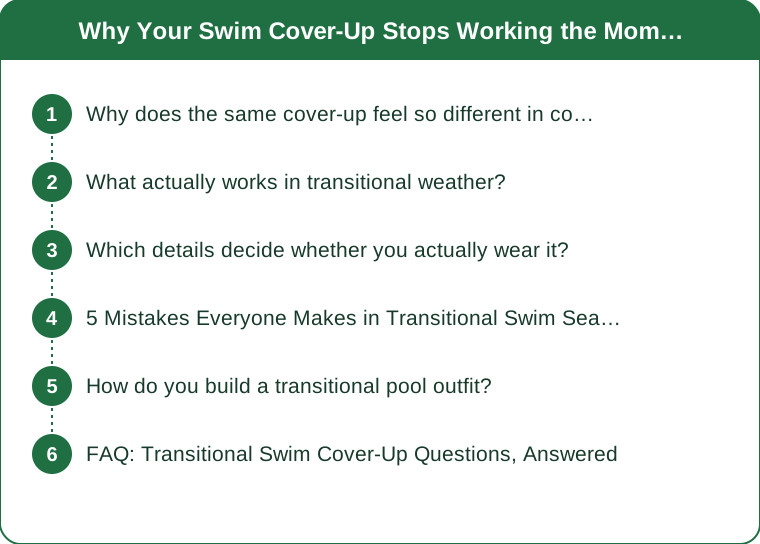
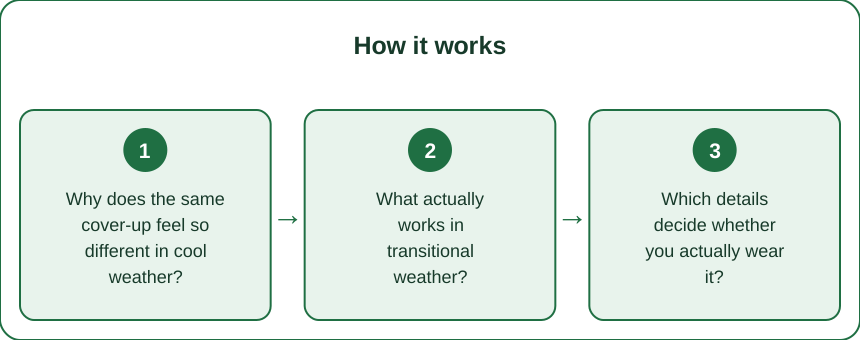
Why does the same cover-up feel so different in cool weather?
Wet skin loses heat through evaporation far faster than dry skin, and the rate rises sharply with air movement. This is the entire mechanism.
Summer cover-ups are designed to maximise airflow, which is exactly what you want at 90F and exactly wrong at 70F.
Air temperature below skin temperature reverses the direction of heat transfer. Above about 92F, moving air warms you; below it, moving air cools you, and the cooling accelerates when you are damp.
Gauze, mesh and open weaves offer essentially no insulation, which was the point when they were bought.
Autumn is also windier in most places, and wind is the multiplier on all of the above.
And the sun angle is lower, so the radiant warmth that compensated for a thin layer at midday in July is substantially reduced by mid-September.
What actually works in transitional weather?
Split the two jobs. Coverage and warmth are separate problems, and one garment doing both badly is worse than two garments each doing one well.
Choose cover-ups with some fabric substance - a mid-weight cotton, a terry cloth, a lightweight knit - rather than gauze. Terry in particular absorbs water off the skin, which removes the evaporative cooling at the source.
Sleeves past the elbow make a disproportionate difference, because the forearms have high surface area relative to their volume.
Length to mid-thigh or below protects the largest area of skin and the parts most exposed to wind while seated.
Add an actual outer layer - an oversized shirt, a zip-up, a light anorak - that goes over the cover-up rather than replacing it. This is the piece most people are missing.
And carry a second towel purely for drying, because getting dry is worth more than any fabric choice. The wettest version of you is the coldest version of you by a wide margin.
Which details decide whether you actually wear it?
The armhole decides comfort more than any other measurement. Too tight restricts, too deep exposes the side body and lets wind straight in. A dropped shoulder with a moderate armhole is the reliable compromise.
The sleeve decides whether it gets worn at all in transitional weather. A three-quarter or full sleeve extends a cover-up’s useful season by weeks in each direction.
Neckline width affects wind entry directly. A wide boat or scoop neck feels great in heat and channels cold air in autumn; a crew or a button-front you can close adjusts.
Ride-up in water is a weight and length problem. Lightweight fabrics float, which is why loose gauze rides up in the water while a mid-weight knit does not.
Side slits are excellent for movement and terrible for wind. Consider where the slit ends relative to where you sit.
Button-front and zip designs adjust in a way pull-on styles cannot, which is exactly the property transitional weather demands.
And a hood is unreasonably effective, because wet hair against the neck is the single largest source of ongoing heat loss after leaving the water.

5 Mistakes Everyone Makes in Transitional Swim Season
Staying in a wet swimsuit under the cover-up. No outer layer overcomes a wet base layer. Change or at minimum wring out and dry off before layering.
Buying one cover-up for the entire season. July and late September are genuinely different climates. A gauzy one and a terry or knit one covers both, and they are frequently inexpensive.
Ignoring the feet. Bare wet feet on cool concrete lose heat rapidly and make everything feel colder than it is. Slides with socks look exactly as expected and work extremely well.
Choosing based on how it looks dry. Cover-ups are worn over damp skin, and many fabrics cling, go transparent or feel unpleasant when wet. Check the fabric wet before committing.
Treating the cover-up as the whole outfit. In transitional weather it is a mid layer. Adding a real outer layer over it costs nothing in style and changes the experience entirely.
How do you build a transitional pool outfit?
Layer one: the swimsuit, which stays wet and should be the layer you can most easily change out of.
Layer two: a mid-weight cover-up with sleeves, ideally terry or knit, which absorbs and insulates rather than ventilates.
Layer three: an outer layer that closes - a zip-up, an anorak, an oversized button shirt. Windproof matters more than warm here.
On the bottom: joggers, wide-leg pants or a longer skirt that go on over a dry suit for the walk home.
On the feet: slides plus socks, or slip-on trainers, with a dry pair kept in the bag.
In the bag: two towels, a dry base layer and a plastic bag for the wet one. The dry base layer is the item people skip and the one that changes the most.
And a hooded piece somewhere in the stack, since wet hair is a persistent heat drain that no other layer addresses.
FAQ: Transitional Swim Cover-Up Questions, Answered
What fabric is best for a cool-weather cover-up?
Terry cloth or a mid-weight cotton knit. Terry absorbs water off the skin, which removes the evaporative cooling that thin fabrics do nothing about.
Why do cover-ups ride up more in the water?
Lightweight fabrics are buoyant and float upward while your body stays put. A slightly heavier fabric and a longer length both solve it.
Should a cover-up be loose or fitted?
Loose through the body for comfort and easy on-off, but not so loose that wind moves through freely. The armhole and neckline matter more than the overall volume.
Can I just wear a regular dress or shirt as a cover-up?
Yes, and an oversized button-down is one of the best transitional options there is - sleeves, adjustable front, and it looks intentional walking to the car.
How do I stop feeling cold after getting out of the pool?
Dry off thoroughly first - that single step matters more than any garment. Then add a dry base layer under the cover-up, and a windproof outer layer over it.
Is it worth buying a season-specific cover-up?
For anyone swimming outdoors past August, yes. A terry or knit style with sleeves extends the usable season by several weeks at each end and they are usually inexpensive.
TL;DR:
- Summer cover-ups are designed for airflow, which is exactly wrong once air temperature drops below skin temperature.
- Wet skin plus wind is the mechanism - evaporative cooling, not the garment’s failure.
- Split the jobs: a mid-weight sleeved cover-up for coverage, a closing outer layer for warmth.
- Terry absorbs water off the skin and removes the cooling at its source; gauze does nothing.
- Sleeves past the elbow and a hood are the two details that extend the season most.
- Dry off properly and change out of a wet suit - no layering overcomes a wet base layer.
The cover-up is a mid layer in transitional weather, not the whole outfit.
Keep Reading
This article is for general informational and styling purposes only. Fit, sizing, and product availability may vary.
