The Armhole Decides Whether a Cover-Up Is Comfortable, Not the Size
Quick Answer: Most cover-up discomfort comes from armhole depth and shape rather than overall size. A shallow armhole cuts into the underarm and restricts lifting the arm; a very deep one exposes the side body every time you move. The workable range is an armhole deep enough to clear the underarm fold with roughly two inches of ease, combined with a side seam that starts below the bust rather than at the armpit.
You sized up twice and it still pinches when you reach for your bag. That is because sizing up mostly adds width at the waist and hip, and the armhole barely changes.

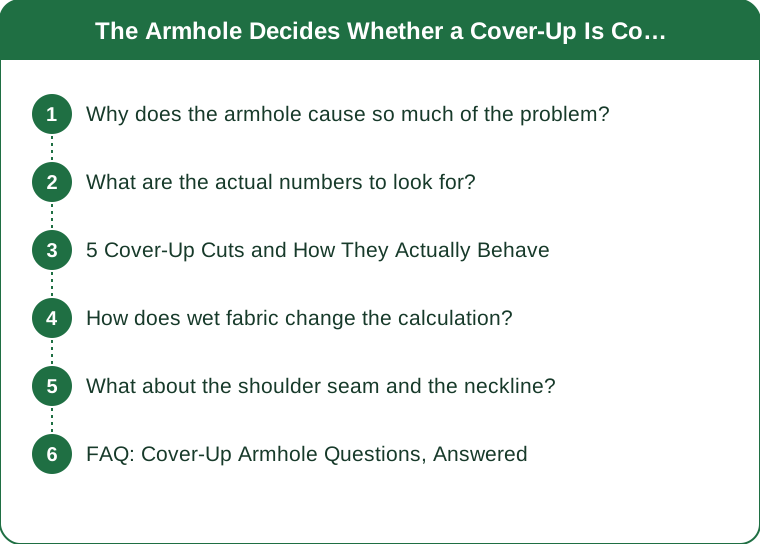
Why does the armhole cause so much of the problem?
Because it is the point where a loose garment stops being loose.
A cover-up is generally cut generously through the body, so the fabric is not the constraint. The armhole is a fixed opening, and every time you lift, reach, or turn, the whole garment pivots around it.
When the armhole is too shallow, the seam sits in the underarm fold. That produces three problems at once: chafing on damp skin, restricted arm lift, and the whole garment riding up when you raise your arm because the fabric has nowhere else to go.
When the armhole is too deep, the opposite happens. The side body is exposed from the bra line down whenever you move, which makes people hold their arms unnaturally close and defeats the purpose of a garment meant to feel easy.
The part that makes this hard to shop for is that armhole depth does not scale much with size. Grading between sizes adds most of its extra fabric to the circumference of the body, so a size 24 often has an armhole only marginally deeper than a size 18.
What are the actual numbers to look for?
You can measure this on a garment you already own, which is more reliable than any size chart.
Lay the cover-up flat and measure the armhole from the shoulder seam straight down to the bottom of the curve. Then compare it to your own measurement: from the top of your shoulder to about two inches below your underarm fold, taken while standing with your arm relaxed.
The garment number should be equal to or slightly greater than yours. Equal is snug but workable in a woven; slightly greater is right for anything you will move in.
For width, the armhole opening laid flat should be roughly half your upper arm circumference plus one and a half to two inches of ease. Less than that and it grips the arm.
The other measurement worth taking is the side seam start. On a well-cut cover-up the side seam begins below the fullest part of the bust, which lets the fabric fall rather than catch. On a poorly cut one it starts right at the armpit, which is what creates the pulling diagonal wrinkle you see in so many fitting-room photos.
Measure your best-fitting existing top once, write the numbers in your phone, and shopping online stops being a lottery.
5 Cover-Up Cuts and How They Actually Behave
1. The kaftan. Deep armhole by design, usually cut as one piece with the sleeve. Best for movement and for larger arms, worst for wind, because the open side catches air.
2. The kimono or open robe. No armhole constraint at all in most versions, since the sleeve is set very low. Extremely comfortable, but the open front means it does no work when you actually want coverage while walking.
3. The dolman or batwing. Armhole effectively extends to the waist. Very comfortable, very forgiving, and it adds visual volume through the upper body, which some people want and some do not.
4. The set-in sleeve tunic. The one that causes the most complaints. A set-in sleeve places a fixed seam at a specific point on the shoulder, and if the shoulder point does not match your frame, nothing else about the fit can compensate.
5. The sleeveless swing dress. Depends entirely on the armhole cut, which varies wildly between brands. Best measured before buying, and the most likely of the five to be either perfect or unwearable.
The one that reframes the shopping list: a raglan or dolman shoulder is almost always more comfortable than a set-in sleeve in this category, because it removes the requirement that the shoulder seam land in exactly the right place. If you have struggled with cover-ups repeatedly, that single filter changes your results more than sizing up again.

How does wet fabric change the calculation?
It tightens everything, which is why a cover-up that felt fine in the store binds at the pool.
Wet fabric clings, and clinging removes ease. An armhole with an inch and a half of ease dry can have almost none wet, because the fabric is now following the contour of the arm rather than hanging away from it.
Wet fabric is also heavier, which pulls the garment down and effectively shallows the armhole further as the shoulder line drops.
And friction rises sharply. Damp skin against damp fabric chafes far faster than either does dry, and the underarm is the highest-friction point on the garment.
The practical implications: build in more ease than seems necessary, favor fabrics that shed water rather than absorb it, and be skeptical of anything with a bound or elasticated armhole edge, because binding that is comfortable dry becomes a tight band wet.
A quick in-store test: raise both arms overhead, cross them, and reach behind you as if fastening a bra. If any of those pull the hem up more than a couple of inches, the armhole is too shallow and it will be worse wet.
What about the shoulder seam and the neckline?
They are the two other structural points, and they interact with the armhole rather than being independent.
A shoulder seam that sits too far out on the arm, common when people size up to solve an armhole problem, drags the whole armhole down and makes the garment feel like it is sliding off. This is the specific failure mode of sizing up: you gain armhole depth and lose shoulder position, and the result is worse than where you started.
A neckline that is too high or too narrow forces the shoulders of the garment inward, which effectively reduces armhole space. This is why a wide scoop or a V often feels roomier through the arms than a crew neck in the same size, even though the armhole measurement is identical.
The combination that works most reliably for larger frames: a wide or V neckline, a dropped or raglan shoulder, and a deep armhole with a side seam starting below the bust.
When those four things line up, size becomes almost a non-issue, which is the actual point. The garment should fit the structure of your frame, and the size number should only handle circumference.
FAQ: Cover-Up Armhole Questions, Answered
Can an armhole be altered?
Deepening one is straightforward for a tailor and inexpensive, since it removes fabric and re-finishes the edge. Making one shallower is much harder. If you are between options, buy the deeper one.
Does a UPF cover-up fit differently?
Often yes, because UPF-rated fabrics tend to be tighter woven and less drapey, so they hang away from the body more but move less. Check the reach test specifically, because the stiffer fabric will not accommodate a marginal armhole.
Why do I chafe under the arm even in a loose cover-up?
Usually the seam finish rather than the fit. A serged or bulky seam allowance sitting in a damp underarm will chafe regardless of ease. Look for flat-felled or bound seams, or turn a garment inside out to check before buying.
TL;DR:
- Armhole depth barely scales with size, so sizing up rarely fixes armhole discomfort
- Measure shoulder to two inches below the underarm fold, and buy a garment that matches or exceeds it
- Raglan and dolman shoulders remove the requirement for a perfect shoulder seam placement
- Wet fabric removes ease and raises friction, so build in more room than feels necessary
Measure your best-fitting top once and save the numbers. Cover-up shopping stops being guesswork and the armhole stops being the reason you leave it in the bag.
Keep Reading
This article is for general informational and styling purposes only. Fit, sizing, and product availability may vary.
