Why Your Swim Cover-Up Stops Working the Week the Weather Turns
Quick Answer: Most cover-ups are designed to help you dry off in warm, still air. In late August the air is cooler and breezier, so the same damp fabric now pulls heat away from you instead of just wicking water. Switching to a thicker weave, a longer cut, or adding one dry layer over the top fixes it — you do not need a different cover-up for every week of the season.
Same suit, same pool, same cover-up you wore happily six weeks ago. This time you get out of the water, pull it on, and within two minutes you are cold in a way that August never used to make you.
Nothing is wrong with the cover-up. What changed is the difference between your wet skin and the air around it, and that gap is what a cover-up is quietly managing.
Here is what shifts at the end of summer, and the smallest change that fixes it.

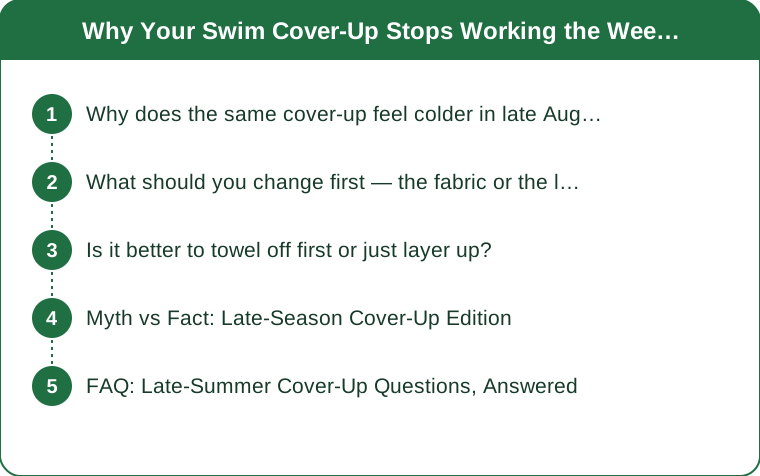
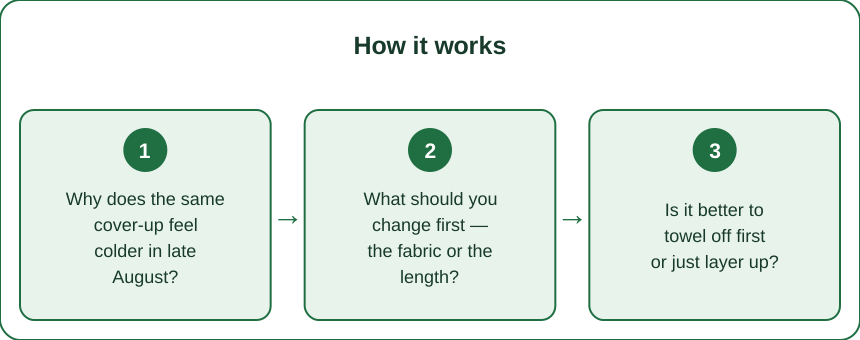
Why does the same cover-up feel colder in late August?
Because a wet cover-up is a cooling device, and cooling devices work harder when the air is cooler.
Evaporation is the mechanism. When water leaves damp fabric, it takes heat with it. In 88°F still air, that heat loss feels pleasant. Drop the air to 74°F and add a breeze off the water, and the exact same evaporation now removes more heat than your body is comfortable replacing.
Thin, open weaves accelerate it. Gauze, crochet, and loose linen were chosen for airflow. Airflow is exactly what you wanted in July and exactly what works against you now. The more breathable the cover-up, the more dramatically it flips when the temperature drops.
Your skin is starting from wetter than you think. Most people put a cover-up on within 30 seconds of leaving the water. The fabric absorbs that water and holds it against you, which extends the cooling for 10 to 15 minutes instead of ending it.
Late-summer air moves more. Even a 5 mph breeze roughly doubles the perceived cooling from damp fabric. This is why the change feels sudden — it is usually a wind shift, not a temperature drop, that makes a familiar cover-up feel wrong overnight.
What should you change first — the fabric or the length?
Fabric, almost always. Length matters for how you look; fabric decides how you feel.
Move up one weight, not three. A mid-weight cotton or a jersey knit holds far less standing water than gauze and stops the wind without feeling like a towel. This single swap solves most late-season discomfort.
Look for a slight nap or texture. Terry, waffle, and brushed jersey trap a thin layer of air against the skin. That trapped air is what keeps the fabric from acting as a cold compress.
Then consider length. A longer cut helps mainly because it covers the backs of your thighs, which is where most people feel the chill first when sitting on a wet chair. If you are already comfortable, extra length adds little.
Sleeves earn their keep now. In July sleeves feel stifling. In late August the tops of your shoulders and upper arms are the surfaces losing heat fastest, and a loose three-quarter sleeve makes more difference than a longer hem.

Is it better to towel off first or just layer up?
Towel off first. It is unglamorous and it beats every fabric upgrade available.
Thirty seconds with a towel changes the physics. Removing most of the standing water on your skin and hair cuts the evaporative cooling dramatically. A cover-up over towel-dried skin behaves the way it did in midsummer.
Hair is the biggest single source. Wet hair against your neck and upper back keeps that area cold long after the rest of you has dried. Wringing it out and clipping it up does more than any garment change.
Then layer, in order. Dry-ish skin, then the cover-up, then one loose outer layer you can remove. Layering over wet fabric traps the cold instead of blocking it — this is the most common late-season mistake.
Keep the outer layer genuinely loose. An oversized shirt or unstructured jacket lets the damp cover-up finish drying underneath. Anything snug seals the moisture in and you stay cold for an hour.
Myth vs Fact: Late-Season Cover-Up Edition
Myth: A darker cover-up is warmer. Fact: color affects how much sun the fabric absorbs, which matters in direct midday light and almost not at all in shade or a breeze. Weave and weight do the real work.
Myth: If it is quick-dry, it will keep you warm. Fact: quick-dry means faster evaporation, which means faster heat loss while it is happening. Quick-dry is excellent for a July afternoon and actively worse on a breezy September morning.
Myth: You need a whole separate autumn cover-up. Fact: one mid-weight layer added to what you already own covers the entire transition. Most people over-buy here.
Myth: Feeling cold after swimming just means the water was cold. Fact: it far more often means the air was moving and your fabric was wet. The water temperature is frequently the least relevant variable.
Myth: Sitting in the sun will fix it. Fact: sun helps while you are in it, but wet fabric under a breeze cools you faster than late-August sun can warm you. Dry the fabric, then enjoy the sun.
FAQ: Late-Summer Cover-Up Questions, Answered
How do I know if a cover-up will work in cooler weather before I buy it?
Hold it up to a window. If you can clearly see the shape of your hand through it, it will move too much air for a cool, breezy day. Then scrunch it in your fist — fabric that springs back with some body will hold warmth; fabric that stays limp will not.
Can I keep wearing my favorite thin cover-up into September?
Yes, as a middle layer rather than the outer one. Put it on over towel-dried skin and add a loose overshirt or light jacket on top. You get the look you like without the cooling.
Why do I feel it more this year than last year?
Two common reasons: you are swimming later in the day than you were in July, and end-of-summer evenings cool off faster than midsummer ones. Same outfit, different hour, completely different result.
TL;DR:
- A wet cover-up cools you by evaporation, and cooler, breezier late-summer air makes that cooling far stronger.
- Move up one fabric weight — mid-weight cotton, jersey, terry, or waffle — before you think about length.
- Towel off for 30 seconds and deal with wet hair first; it beats any fabric upgrade.
- Layer in order: dry-ish skin, cover-up, then one loose removable outer layer. Never seal a wet layer under a snug one.
- You do not need a new cover-up for autumn, just one extra layer over the one you own.
The transition weeks catch almost everyone off guard because the calendar still says summer. Treat the cover-up as one part of a two-layer system instead of the whole answer, and the outfit you loved in July keeps working straight through September.
Keep Reading
This article is for general informational and styling purposes only. Fit, sizing, and product availability may vary.
