Why an Indoor Pool Cover-Up Needs Completely Different Fabric Than a Beach One
Quick Answer: A beach cover-up is designed to breathe, dry fast, and block sun. An indoor pool cover-up has the opposite job: retain warmth over damp skin in a humid room and survive constant chlorine exposure. Loose linen and open-weave cotton do nothing indoors - you need something that traps a layer of warm air and dries reasonably. The best indoor choices are a mid-weight terry or a brushed knit with a full zip or front opening; the worst are linen, gauze, mesh, and anything sheer.
The fabric that made summer comfortable is the wrong tool for a year-round pool routine.
Here is how to pick the right one.

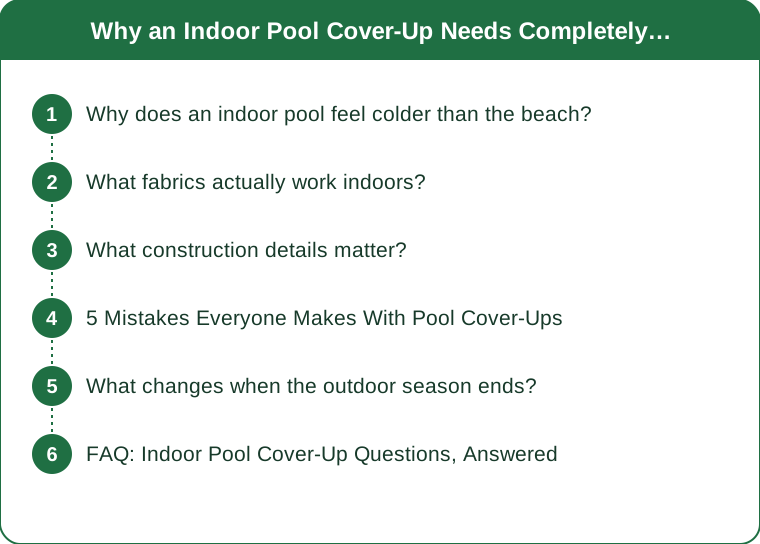
Why does an indoor pool feel colder than the beach?
Because of evaporation, and the indoor environment makes it worse rather than better.
Wet skin loses heat rapidly through evaporation, and the effect is far stronger than the air temperature alone suggests. A pool deck at 82°F feels genuinely cold when you are wet.
Indoor pool halls are humid but moving. Ventilation systems create constant low-level air movement, and moving air over wet skin accelerates evaporative cooling considerably. There is no sun to offset it.
And the walk is longer. At a beach you are usually in and out of the water. At an indoor pool you walk from the water to the locker room, wait, and often walk out into a cold parking lot - a much longer chilled period.
The cover-up’s job is therefore reversed. Outdoors, it shades you and lets heat escape. Indoors, it needs to trap a layer of warm air against damp skin and reduce evaporation.
Which is why linen fails completely. Its open weave is engineered to move air through it. The exact property that makes it wonderful in August makes it useless in a pool hall.
What fabrics actually work indoors?
In order of how well they do the job.
Mid-weight terry cloth. Absorbs water off the skin and traps warm air in the loops. A terry cover-up is a towel you can walk in, which is precisely what an indoor pool calls for. Look for a mid-weight rather than a heavy one, which takes forever to dry.
Brushed or fleece-backed knit. Very warm, dries reasonably, and comfortable over damp skin. A brushed-back cotton or poly blend is excellent for the walk to the locker room and for the drive home.
French terry. Lighter than towel terry, smooth on the outside, looped inside. The best all-round compromise - warm enough at the pool, presentable enough to wear out.
Microfiber. Very fast drying and packs small, though less warm. Good for a swim followed immediately by leaving.
What does not work indoors: linen, cotton gauze, mesh, crochet, and anything sheer. All of them are built to let air through - and sun protection, the main reason to wear them, is irrelevant indoors.
And chlorine changes the durability math. Elastane degrades quickly with repeated chlorine exposure, so a cover-up with high elastane content will lose its shape fast in a regular pool routine. Cotton-dominant or poly-dominant fabrics with minimal stretch last far longer.
What construction details matter?
The opening is the most important, and it is the one people ignore.
A full front opening - zip or snaps. You will be putting this on over wet skin, and pulling anything over your head while wet is genuinely difficult. A zip or snap front solves the single most annoying part of indoor swimming.
A hood. Wet hair is the largest ongoing source of heat loss on the walk out. A hood matters more indoors in winter than any other feature, and it is the difference between a comfortable walk to the car and a cold one.
Pockets. Locker key, phone, goggles. Deep enough that a key does not fall out when you sit down.
Length to mid-thigh or below. Longer covers more, and there is no heat-related reason to keep it short indoors.
Sleeves. Beach cover-ups are often sleeveless; indoors, sleeves are doing real work. Three-quarter or full length.
Roomy through the shoulders. You need to be able to get it on over damp skin without a struggle. Size for ease of putting on, not for a fitted look - this is a functional garment.
And avoid metal hardware where possible. Chlorine and humid pool air corrode metal zips and snaps quickly. Plastic or coated hardware lasts far longer in a pool environment.

5 Mistakes Everyone Makes With Pool Cover-Ups
1. Using the summer cover-up year round. Covered above - the fabric is designed to do the opposite job. Keep it for the beach and buy a separate one for indoor swimming.
2. Leaving it damp in a gym bag. Chlorine-damp fabric in a sealed bag develops mildew and odor within a day. Hang it as soon as you get home, every time.
3. Not rinsing after swimming. Chlorine keeps degrading fabric after you leave the pool. A quick rinse in cool water dramatically extends life, and it takes thirty seconds.
4. Buying with high elastane content. Stretch fabric feels comfortable in the store and loses its shape fastest in a chlorine environment. Look for minimal elastane in anything worn regularly at a pool.
5. Buying something too fitted. It has to go on over wet skin, often quickly, sometimes in a crowded changing area. A cover-up that requires effort to put on is one you will stop bringing.
What changes when the outdoor season ends?
The whole use case shifts, and it is worth thinking about before November.
The pool becomes a year-round routine rather than a summer activity. Indoor swimming picks up sharply once outdoor options close, which means the cover-up goes from occasional to several times a week - and durability suddenly matters.
The temperature difference at the exit becomes extreme. Walking from a warm humid pool hall into cold outdoor air is a much bigger shock than anything summer produces. A hood and full sleeves are genuinely functional here, not stylistic.
Wet hair is the biggest single factor. The head loses meaningful heat, and wet hair in cold air is uncomfortable and slow to recover from. A hood or a dedicated hair towel changes the whole experience.
Drying time matters more. In a cool, less ventilated home, a heavy terry cover-up may not dry between sessions. If you swim more than twice a week, either own two or choose a lighter french terry.
And layering the exit is worth planning. Cover-up over the swimsuit, then a warm outer layer over that for the walk out - it is faster than fully changing and warmer than either alone. Many regular swimmers land on this system eventually; it is worth arriving at it deliberately.
FAQ: Indoor Pool Cover-Up Questions, Answered
Can I just use a towel?
You can, and it does not stay on. A wrapped towel needs a hand to hold it, which you need for a locker key, goggles, and a door. A cover-up with a zip solves the problem a towel keeps creating.
Does UPF matter for an indoor pool?
No - there is no meaningful UV indoors. Any UPF rating on an indoor cover-up is irrelevant, so ignore it and buy for warmth and durability instead.
How do I get the chlorine smell out?
Rinse in cool water immediately after swimming, then wash with a small amount of detergent and a cup of white vinegar in the rinse. Skip fabric softener - it coats the fibers and traps the odor rather than removing it.
TL;DR:
- Indoor and outdoor cover-ups have opposite jobs - one breathes and shades, the other traps warmth over damp skin.
- Choose terry, french terry, or a brushed knit. Linen, gauze, and mesh do nothing indoors.
- A full zip or snap front is the most important feature - pulling anything over wet skin is miserable.
- A hood matters more than you expect because wet hair drives most of the heat loss on the way out.
- Minimal elastane and non-metal hardware last far longer in chlorine.
- Rinse after every swim and hang it immediately - damp chlorinated fabric in a bag is how cover-ups die.
Before the outdoor season closes, buy the indoor one. The first cold walk to the car in November is not the moment to discover the difference.
Keep Reading
This article is for general informational and styling purposes only. Fit, sizing, and product availability may vary.
