Why Fabric Weight Decides Whether a Cover-Up Clings When Wet
Quick Answer: A cover-up clings when the fabric absorbs enough water to become heavy and translucent while lacking the body to hold its shape. Look for gsm in the 120 to 180 range in a fabric with texture or drape — gauze, seersucker, or a slubbed cotton — rather than thin flat jersey, which is the worst performer wet.
You put the cover-up on over a wet swimsuit and within twenty seconds it has become a second skin, gone slightly transparent, and adhered to everything you did not want it adhering to. The cover-up you bought last year did not do this. The style was similar. The fabric was not.

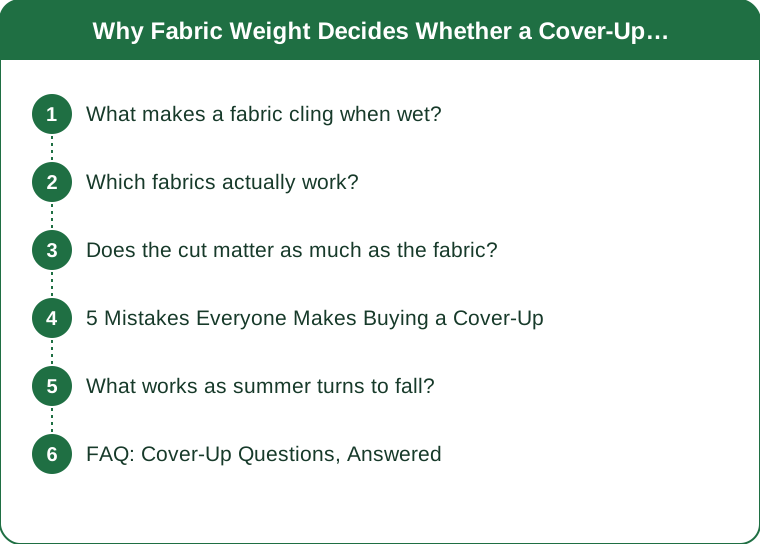
What makes a fabric cling when wet?
Water in the fabric creates surface tension between the cloth and your skin, and it adds weight without adding structure.
Three properties determine how badly this happens.
Weight, measured in gsm — grams per square meter. Very light fabrics under about 100 gsm saturate fast and have no mass to fall away from the body. Very heavy fabrics take forever to dry. The sweet spot for a cover-up is roughly 120 to 180 gsm.
Surface texture. A flat, smooth fabric makes full contact with skin. A textured one — seersucker, crinkle gauze, slub, waffle — touches at high points only, so there is less contact area for water to bridge.
Drape versus stretch. Woven fabrics hang away from the body. Knits stretch and mold to it. A thin jersey knit is the single worst choice for a wet cover-up, and it is also the most common.
Which fabrics actually work?
In rough order of reliability when wet:
- Cotton gauze or double gauze. Textured, light, dries fast, and the crinkle keeps it off the skin. The most reliable option overall.
- Seersucker. The puckered structure is literally designed to hold fabric away from skin. Excellent wet, and it never needs ironing.
- Linen and linen blends. Great drape and fast drying. It does go somewhat translucent when wet, so a mid or dark tone works better than white.
- Slubbed or textured cotton. The irregular surface breaks up skin contact.
- Lightweight woven rayon or viscose. Beautiful drape dry; becomes noticeably heavier and more translucent wet than cotton does.
What to avoid: thin jersey knits, modal knits, and anything described as buttery soft. They are lovely in a fitting room and they cling the instant they meet water. Also avoid pure white in any fabric unless you have checked it wet.
The fitting-room test that actually predicts this: hold the fabric up to the light. If you can see your hand clearly through it dry, it will be transparent wet.
Does the cut matter as much as the fabric?
It matters, but it cannot rescue the wrong fabric.
Cuts that work with wet fabric:
- A-line and swing shapes, which have enough volume that even a damp fabric falls away from the body
- Kaftan and caftan cuts with a defined shoulder and a loose body
- Button-front shirt dresses, which can be worn open — nothing clings if it is not in contact
- Anything with a defined shoulder seam, since a garment that hangs from the shoulder rather than draping over the bust distributes wet weight better
Cuts that fail wet regardless of fabric: bodycon shapes, anything relying on stretch for fit, and sarongs or wraps that need to be tied tightly against a wet body.
A key detail people miss: armhole size. A generous armhole means the garment can move independently of your body, and independence is exactly what prevents clinging.

5 Mistakes Everyone Makes Buying a Cover-Up
-
Trying it on dry only. The whole use case is wet. At minimum, hold it to the light and check the drape when you pull it against your arm.
-
Buying white or pale. Nearly every fabric goes more translucent wet, and pale colors show it most. Mid-tones and prints are dramatically more forgiving.
-
Buying a knit because it felt soft. The third mistake on most lists is the sneaky one; here it is the most consequential. Softness in the store is not a predictor of anything relevant.
-
Sizing up to prevent clinging. A larger size in a clinging fabric clings in a larger size. Fabric choice, not size, is the variable.
-
Forgetting about late-season use. A cover-up bought in June for July gets its most use in late August and September, when evenings cool off. A slightly longer sleeve and a slightly heavier fabric extend its season by a month at no cost in comfort.
What works as summer turns to fall?
The late-August and September beach or pool day has different requirements, and one cover-up can cover both if you choose correctly.
Move up in weight slightly, toward the top of the 120 to 180 gsm range, or to a double gauze that has two layers of light fabric rather than one heavier one.
Longer sleeves become an asset rather than a compromise. A three-quarter or full sleeve in gauze is barely warmer at midday and considerably warmer at six.
Consider length. A midi or maxi that felt like too much in July is exactly right when the evening breeze arrives.
Look for a button front. Open at noon, closed at seven. It is the single most versatile detail for shoulder-season use.
That combination — mid-weight gauze, button front, three-quarter sleeve, midi length, mid-tone color — is close to the most useful single cover-up you can own, and it works from June through the last swim of the year.
FAQ: Cover-Up Questions, Answered
What gsm should I look for exactly?
Roughly 120 to 180 for a general-purpose cover-up. Under 100 saturates and goes sheer; over 200 stays heavy and damp long after you have dried off.
Do cover-ups provide sun protection?
Some do. Look for a UPF rating if that is a priority — a loose weave in a light color may block much less UV than it appears to. A rated garment is the only way to know.
How do I stop it going see-through?
Choose a mid-tone or a print, choose a textured weave over a flat one, and check it against the light before buying. Lining is rare in cover-ups, so the fabric itself has to do the work.
TL;DR:
- Clinging is about fabric weight, texture, and drape — not cut, and not size
- Aim for 120 to 180 gsm in gauze, seersucker, linen, or slubbed cotton
- Avoid thin jersey knits, buttery-soft fabrics, and white in any fabric
- A mid-weight gauze button-front midi with a three-quarter sleeve covers June through September
The reason cover-up shopping goes wrong so often is that the fitting room tests the wrong condition. Everything looks good dry. Hold it up to the light, check whether it is a woven or a knit, and buy the one with a bit of texture — that is the whole decision, and it is the difference between a cover-up you actually wear and one that stays in the bag.
Keep Reading
This article is for general informational and styling purposes only. Fit, sizing, and product availability may vary.
