Why Your Cover-Up Colour Decides How Sheer It Goes When Wet
Quick Answer: Fabric turns sheer when wet because water fills the air gaps between fibres and reduces light scattering — the same optical effect that makes wet paper translucent. Light colours become dramatically more see-through because they rely on scattering for their opacity, while dark dyes rely on absorption, which water does not undo. A deep colour, higher fabric weight and a textured or patterned surface all substantially reduce wet sheerness.
It looked perfect in the shop. Opaque, floaty, exactly right.
Then it got splashed and turned into a completely different garment.
You could have predicted it from the colour alone.

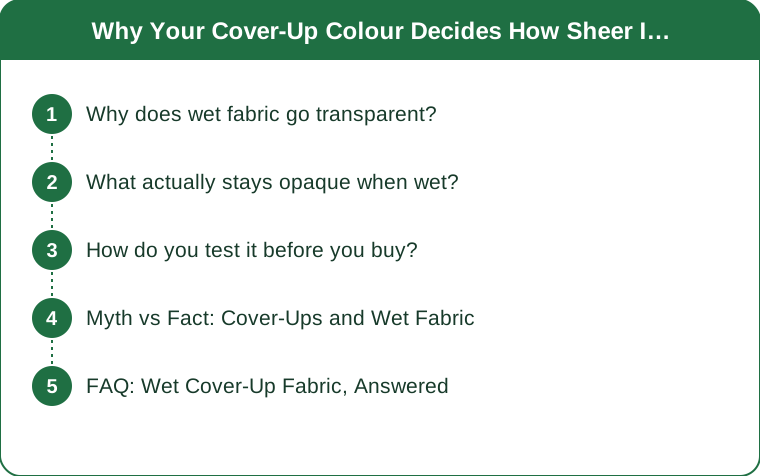
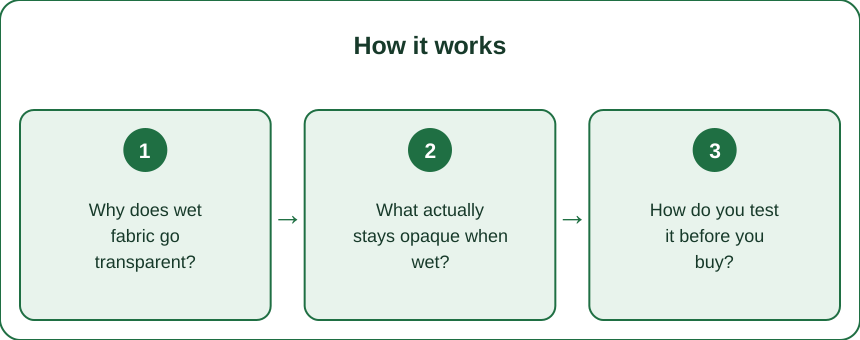
Why does wet fabric go transparent?
Because opacity in dry fabric comes largely from air, and water replaces it.
Dry fabric scatters light at fibre-air boundaries. Every fibre surface bounces light in a new direction, and all that scattering is what makes fabric look opaque.
Water has a refractive index close to fibre. When water fills the gaps, light passes from fibre to water with much less bending, so far less scattering occurs and more light passes straight through.
It is the same reason wet paper turns translucent. Identical physics, more familiar example.
Light colours lose the most. A white or pastel fabric appears opaque mainly because of scattering. Remove the scattering and there is very little left to stop light.
Dark colours absorb, and absorption survives. A navy or black dye absorbs light regardless of whether the fabric is wet. That mechanism is unaffected by water, which is why dark cover-ups stay far more opaque.
Fabric weight is the other half. More fibre mass means more absorption and more remaining scattering, so a heavier fabric of any colour holds up better than a light one.
What actually stays opaque when wet?
Five properties, and you can check all of them before buying.
Deep colours. Navy, black, deep green, burgundy, chocolate. These are the reliable performers, and the difference against pastels is large rather than marginal.
Higher fabric weight. Heavier fabrics keep more of their opacity. Lightweight gauzes and voiles are the worst performers regardless of colour.
Prints and patterns. A busy print breaks up whatever does show through. This is why patterned cover-ups outperform plain ones of the same weight.
Textured weaves. Crinkle, seersucker and slub textures hold air even when damp, and the uneven surface disrupts the light path.
Double layers. Any lined or double-layer panel is effectively immune to the problem, which is why lined side panels are worth looking for.
And the one that is not intuitive: mid-tones behave less predictably than either extreme. A mid-grey or dusty pink can look fine dry and become quite sheer wet, which is why the wet test matters more for those than for either white or black.

How do you test it before you buy?
Two tests, thirty seconds, and they work in any changing room.
The hand test. Stretch a single layer of the fabric over your own hand. If you can clearly read your skin tone through it dry, wet will be substantially worse.
The dampen test. If you can, dampen a small area with a fingertip of water and hold it up. This is the only test that gives you the real answer, and most shops will not mind.
Check under bright light. Changing room lighting is usually dimmer than a poolside or a beach. Hold the fabric up toward the brightest light available.
Look at the weight label. Where it is given, higher GSM means more opacity. Anything marketed as ultra-light or gauzy is telling you what it will do wet.
Check where the lining stops. Many cover-ups line the body and not the sleeves or lower panel, which is where the surprise comes from.
Seasonal note: end-of-summer sales are dominated by exactly the lightweight pale styles that perform worst, because those are what did not sell. If you are buying now for next year, the discount on a pale gauze is not a bargain, and a deep-toned mid-weight piece at a smaller discount is the better purchase.
Myth vs Fact: Cover-Ups and Wet Fabric
Myth: Expensive cover-ups do not go sheer
Fact: Price is unrelated. Colour, weight and weave decide it, and plenty of expensive pieces are lightweight pale gauze.
Myth: Natural fibres are more opaque when wet
Fact: Cotton and linen absorb more water and can go sheerer than quick-drying synthetics of the same weight.
Myth: A UPF rating means it will stay opaque
Fact: UPF measures ultraviolet blocking, not visible-light opacity, and UPF ratings can also drop when fabric is wet and stretched.
Myth: White is cooler so it is worth the trade-off
Fact: The temperature difference in a light fabric is small. The opacity difference is large.
Myth: It only matters at the pool
Fact: Sweat and humidity produce a milder version of the same effect. This applies to any warm-weather layer, not just swimwear.
Myth: Lining always solves it
Fact: Only where the lining actually is. Check the sleeves, the hem panel and the back, which are the most commonly unlined areas.
FAQ: Wet Cover-Up Fabric, Answered
Which colours are safest?
Deep, saturated tones — navy, black, deep green, burgundy. They rely on absorption, which water does not affect.
Are prints better than plain?
Yes, meaningfully. A busy pattern disrupts whatever shows through, and it is one of the most effective and least discussed factors.
Does fabric weight matter more than colour?
They work together. A heavy pale fabric can outperform a light dark one, but for any given weight, darker is more opaque wet.
Do quick-dry fabrics help?
They shorten the sheer window rather than preventing it, which is genuinely useful. The garment is only compromised while wet.
Will it change over time?
Yes. Chlorine, salt and UV degrade fibres and fade dye, and a faded piece is more sheer wet than it was new. Rinse after every swim.
What about indoor pools specifically?
Bright overhead lighting is less forgiving than diffuse outdoor light, so indoor pools show sheerness more readily. Choose deeper colours for indoor swimming.
TL;DR:
- Wet fabric goes sheer because water replaces air and removes the light scattering that creates opacity.
- Light colours rely on scattering and lose most of it; dark dyes absorb, which water does not undo.
- Deep colours, higher weight, prints and textured weaves all stay opaque wet.
- Test with the hand test and, where possible, a damp fingertip before buying.
- Faded pieces go sheerer than new ones — rinse after every swim to slow it.
Before the next purchase, hold it over your hand toward the brightest light in the shop. Ten seconds, and it settles the question.
Keep Reading
This article is for general informational and styling purposes only. Fit, sizing, and product availability may vary.
