Why a Cover-Up That Works at the Pool Fails at the Beach
Quick Answer: A pool environment is enclosed, still, and has hard surfaces; a beach has wind, sand, and much longer periods of sun exposure. Cover-ups designed for pool use tend to be short, light, and loose — which is exactly the combination that blows around, traps sand, and fails to provide meaningful sun coverage. A beach cover-up needs weight, a way to be secured, and enough length and sleeve coverage to actually do the job you are asking of it.
Most people conclude they picked a bad cover-up. They picked a pool cover-up and took it to a beach.

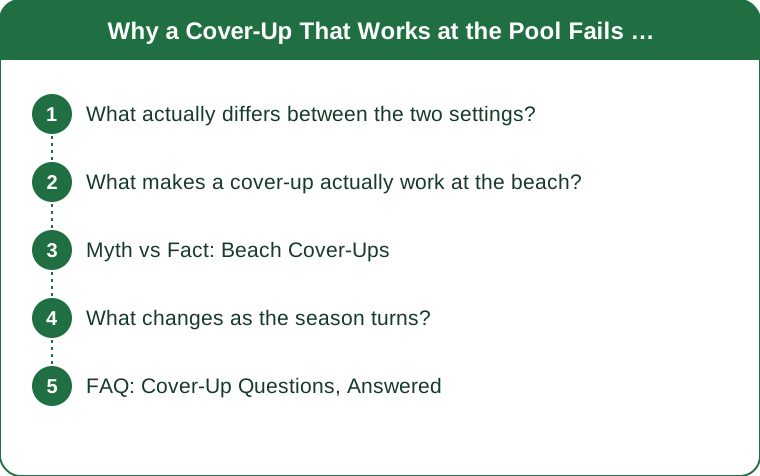
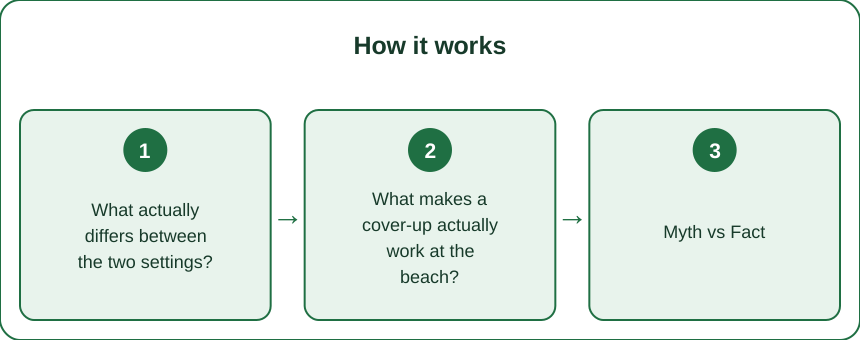
What actually differs between the two settings?
Three things, and each one breaks a different design assumption.
Wind. A pool deck, especially an indoor or courtyard one, is largely still. A beach usually is not. A light, loose, unstructured garment behaves completely differently in a 15 mph onshore breeze — it lifts, it wraps, and it requires constant management.
Sand. Sand gets into everything, and open-weave fabrics, crochet, and anything with texture hold it. It also abrades — sand trapped between fabric and skin during movement is genuinely uncomfortable over a few hours. Smooth, tightly woven fabric releases sand; textured fabric keeps it.
Duration and sun exposure. A pool visit is often an hour or two with shade nearby. A beach day is frequently four or more hours with limited shade. A cover-up at the beach is functioning as sun protection, which is a different requirement from looking put together on the walk from the lounger to the bar.
There is a fourth, quieter difference: the beach has no changing room. A cover-up that requires stepping out of and into carefully is unworkable when it is also your changing tent.
What makes a cover-up actually work at the beach?
Four properties, in rough order of importance.
Some weight to the fabric. A garment with a bit of body — a mid-weight cotton, a linen blend, a light gauze with substance — hangs rather than flies. Very light chiffon and thin knits are the ones that spend the day wrapping around you.
A way to secure it. A wrap tie, a drawstring, a button front, or a belt. Anything with a closure beats anything that only drapes, because the wind will find any opening. A kaftan with no closure is a pool garment.
Real coverage where you want it. If sun protection is part of the job, that means sleeves of some kind and length past the hip. A short sleeveless cover-up leaves shoulders and upper back exposed — the areas that burn first and worst.
A smooth, tight weave. For sand release, and for putting it on over damp skin. Open crochet and heavily textured fabrics are the two that trap sand and are hardest to pull over a wet swimsuit.
The garment that satisfies all four is usually a mid-length button-through or wrap shirt-dress in a linen-cotton blend — which is not what most cover-up ranges are selling, and is why so many people end up buying a men’s linen shirt instead.

Myth vs Fact: Beach Cover-Ups
Myth: Lighter fabric is cooler. Fact: Up to a point. A very light fabric that clings when damp and blows against you is often less comfortable than a slightly heavier one that holds its shape and creates an air gap. The air gap is what does the cooling.
Myth: Any fabric provides sun protection. Fact: A loose white cotton weave can have a UPF as low as 5 to 7, and it drops further when wet. Tighter weaves and darker or brighter colors provide considerably more protection, and rated UPF fabrics more still.
Myth: Long means hot. Fact: A loose long garment in a breathable fabric is frequently cooler in direct sun than bare skin, because it blocks radiant load while allowing evaporation. Length is not the enemy; tightness is.
Myth: A sarong is a cover-up. Fact: A sarong is a versatile piece of fabric and, in wind, it is a full-time job. It works well as a towel, a seat, a shade, and a shoulder wrap. As a garment on a windy beach it requires more management than most people want.
Myth: You should size up for a cover-up. Fact: Size for the shoulders and the armhole, which is what determines whether it goes on easily over damp skin. Excess width elsewhere just gives the wind more to work with.
What changes as the season turns?
Everything about the temperature calculation, while the sun exposure stays significant.
Late summer and early autumn beach days have a specific pattern: warm sun, cool wind, and a temperature that drops sharply once the sun lowers. A cover-up that was adequate in July becomes inadequate at 5pm in September, and it is usually the wind rather than the air temperature that decides it.
The practical response is a two-piece approach. The light cover-up handles sun during the day; a separate layer with some wind resistance handles the late afternoon. One garment cannot do both jobs well, and trying to find one is why so many people end up cold and leaving early.
Sleeve length becomes more valuable as the season shifts. A long loose sleeve provides sun coverage during the day and warmth in the evening, which is a genuine dual purpose that a sleeveless garment cannot offer.
And the sun itself has not eased as much as it feels. UV remains significant into early autumn even when the air is noticeably cooler, and the cooler air removes the sensation that normally prompts people to seek shade. Early-autumn sunburn is common for exactly this reason.
One practical note that applies year-round: whatever you choose, test putting it on over a wet swimsuit before you commit to it for a whole day. That single test eliminates a large share of bad cover-up purchases.
FAQ: Cover-Up Questions, Answered
What is the most versatile single cover-up?
A mid-length button-through shirt-dress in a linen-cotton blend. It closes against wind, opens for airflow, provides sleeve coverage, goes on over damp skin, and does not read as beach-only when you stop for lunch.
Does a wet cover-up still protect from sun?
Most fabrics lose a significant amount of their UPF when wet — sometimes half. If sun protection matters, either let it dry or choose a rated UPF fabric, which retains protection when wet.
How do I stop a cover-up riding up in water?
Do not wear one in the water. Cover-ups are not swim garments; the fabric becomes heavy, clings, and rides. If you want in-water coverage, a rash guard or a swim dress designed for it is the right garment.
TL;DR:
- Wind, sand, and long sun exposure are what separate a beach from a pool — and cover-ups are designed for the pool.
- Choose some fabric weight, a closure, real length and sleeve coverage, and a smooth tight weave.
- Loose and long is cooler in direct sun than bare skin; tight is the problem, not length.
- In early autumn, use one light layer for sun and a separate wind layer for the evening.
Test any cover-up by putting it on over a wet swimsuit. Most failures show up in that one moment, before you have spent a day finding out.
Keep Reading
This article is for general informational and styling purposes only. Fit, sizing, and product availability may vary.
