Why a High UPF Rating on a Swim Cover-Up Doesn't Mean What Most People Think
Quick Answer: A UPF rating measures how much of the sun’s UV radiation a fabric blocks when it’s dry, worn as intended, and not stretched or worn thin — it doesn’t account for wet fabric (which can lower effective protection), looser weaves that gap when stretched over the body, or areas the cover-up simply doesn’t cover, so a UPF 50+ label is a fabric property, not a full-body guarantee.
A UPF 50+ tag feels like a promise that you’re covered, but the number is only describing the fabric under ideal test conditions — not the cover-up on your actual body, in actual water, on an actual beach day.
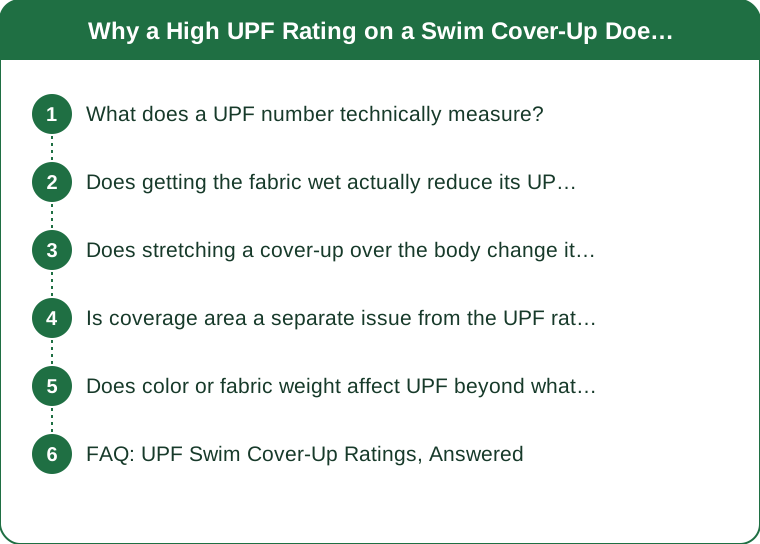
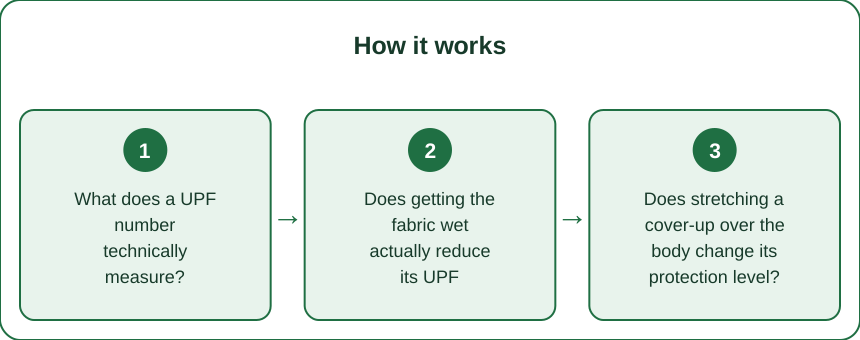
What does a UPF number technically measure?
UPF (Ultraviolet Protection Factor) measures the fraction of UV radiation a specific fabric blocks under standardized lab testing conditions, with UPF 50 meaning roughly 1/50th of UV radiation passes through the dry, unstretched fabric — it’s a fabric-level lab measurement, not a measurement of how the garment performs once it’s actually worn, wet, or stretched over a body.
Does getting the fabric wet actually reduce its UPF protection?
For many fabrics, yes — wet fabric can have a measurably lower effective UPF than the same fabric dry, since water can change how light passes through certain weave structures, and this is a widely underappreciated gap between the label and real pool or beach conditions where the fabric is wet most of the time it’s actually being worn.
Does stretching a cover-up over the body change its protection level?
Yes, potentially significantly — stretching a knit or loosely woven fabric can open small gaps between fibers that weren’t present in the flat, unstretched lab sample used for UPF testing, meaning a cover-up that’s tight across the shoulders or hips may offer less real protection there than the labeled UPF suggests for the fabric in its resting state.
Is coverage area a separate issue from the UPF rating itself?
Yes, and it’s often the bigger practical gap — a UPF 50+ rating says nothing about how much of the body the garment actually covers, so a high-UPF cover-up with short sleeves and an open back still leaves meaningful skin exposed, while a lower-UPF garment with full coverage might provide more overall protected surface area.
Does color or fabric weight affect UPF beyond what’s on the label?
Generally the labeled UPF already accounts for the specific fabric tested, but darker colors and denser, heavier weaves generally correlate with higher UPF than light colors and thin, loose weaves of similar fiber content — which is useful context if choosing between two cover-ups that don’t have a tested UPF label at all.
FAQ: UPF Swim Cover-Up Ratings, Answered
Does a UPF 50+ cover-up mean sunscreen underneath is unnecessary?
No — most guidance still recommends sunscreen on any exposed or thinly covered skin, since UPF garments address only the fabric-covered area and can still have real-world gaps discussed above.
Does fabric UPF degrade over time with repeated washing and sun exposure?
Some fabrics do show gradual UPF reduction with heavy wear, washing, and chlorine exposure over a season or more, though this varies by fabric type and construction.
Is a UPF rating required by law to appear on all swimwear?
No — UPF labeling is generally voluntary and based on independent lab testing, so cover-ups without any UPF label aren’t necessarily unprotective, just untested or unlabeled.
TL;DR:
- UPF measures a fabric’s UV blocking under dry, unstretched lab conditions, not real-world wear
- Wet fabric and stretched fabric can both offer meaningfully less protection than the labeled UPF
- Coverage area matters as much as the rating itself — a high UPF with little coverage still leaves skin exposed
- Darker, denser, tighter-weave fabrics generally provide more protection than light, loose ones
A UPF label is a useful starting point, not a finish line — sunscreen underneath and checking actual coverage still matter, wet fabric and stretch included.
Keep Reading
This article is for general informational and styling purposes only. Fit, sizing, and product availability may vary.
