Why Most Swim Cover-Ups Fit on the Rack but Not on the Beach
Quick Answer: Cover-ups often fit fine standing still and fail the moment you sit, bend, or walk in wind — the fix is checking three motion points before buying: does it gape when you bend forward, does the hem rise when you sit, and does it billow uncomfortably in a breeze. A style tested against actual movement, not just a flat lay, solves all three.
A cover-up gets tried on standing in front of a mirror, looks great, and gets bought. Then it gapes at the chest reaching for a towel, rides up sitting in a beach chair, or turns into a parachute in any wind — none of which shows up in that first standing-still check.

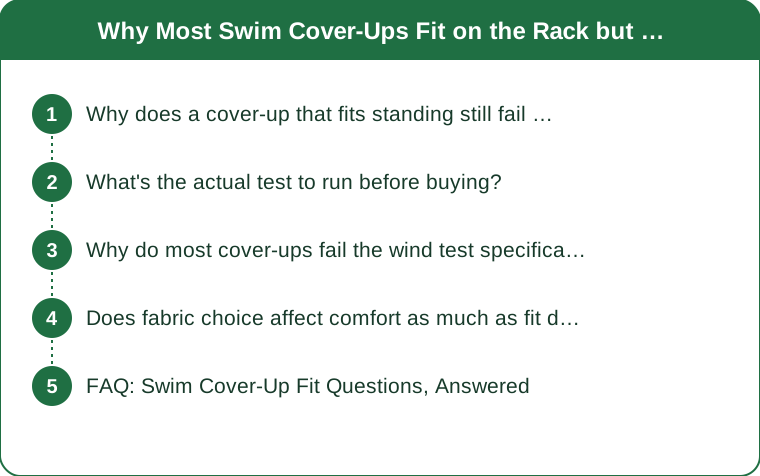
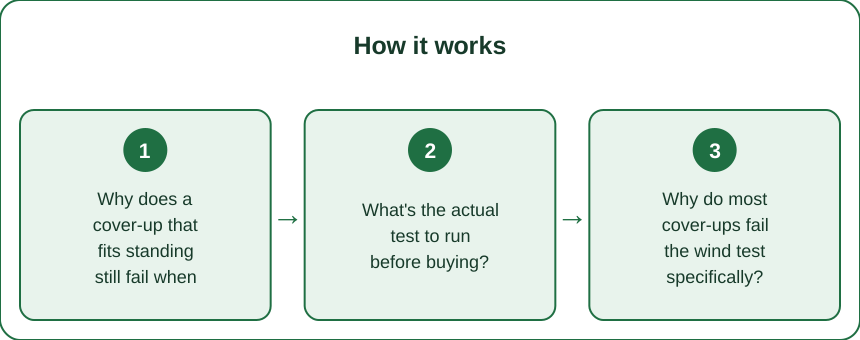
Why does a cover-up that fits standing still fail when you move?
Because standing still is the least demanding test possible for how a garment behaves — it’s the equivalent of trying on shoes without walking in them. Bending, sitting, and reaching all pull fabric in directions a static try-on never tests.
A wrap-front style that looks secure standing can gape wide open bending forward if the wrap doesn’t have a secure tie or enough overlap. A short hemline that looks fine standing can ride up significantly higher sitting down in a low beach chair.
What’s the actual test to run before buying?
Three quick checks, in the fitting room or at home: bend forward like you’re reaching for a bag — does the front gape? Sit down in a low chair — where does the hem land? Raise your arms overhead — does the whole cover-up ride up with them? A style that passes all three will behave the same way at the beach as it did in the mirror.

Why do most cover-ups fail the wind test specifically?
Lightweight, flowy fabric is chosen for comfort and drape, which is exactly what makes it catch wind. A cover-up with some structure or weight — a slightly heavier weave, a tie at the waist that anchors the silhouette — resists billowing far better than an ultra-lightweight version, without sacrificing much breathability.
A cover-up with side ties or a defined waist also just stays in place better generally, wind or no wind, compared to a fully loose shift style.
Does fabric choice affect comfort as much as fit does?
Yes — a cover-up that fits perfectly but clings uncomfortably when slightly damp (from sitting on a wet chair, brushing against a wet suit) creates its own frustration. Linen-blend or lightweight woven cotton tends to handle a little dampness better than clingy jersey knits, which stick and outline in a way many people find uncomfortable at the beach specifically.
FAQ: Swim Cover-Up Fit Questions, Answered
Should a cover-up be sized the same as your regular clothing size?
Check actual measurements rather than assuming — cover-ups vary widely in cut (oversized shift vs. fitted wrap), so the same size label can fit very differently between styles.
Are ties always better than a fixed closure?
Ties offer more adjustability across a changing day (post-lunch comfort, for example), but a well-placed button or snap can be just as secure and faster to manage — the key factor is secure closure, not the closure type itself.
What length cover-up is most versatile?
A length that hits mid-thigh to just above the knee tends to work across the widest range of activities — beach walking, restaurant-adjacent errands, poolside lounging — without the sitting-rise problem that shorter lengths run into.
TL;DR:
- Standing-still fit doesn’t predict real-world behavior — test bending, sitting, and arms overhead
- Wrap styles need secure ties and enough overlap to survive bending forward
- Some structure (heavier weave, waist tie) beats ultra-lightweight fabric for wind resistance
- Linen-blend or lightweight woven cotton handles dampness better than clingy jersey
Run the three-point movement test before buying, and the cover-up that worked in the mirror will actually work at the beach.
Keep Reading
This article is for general informational and styling purposes only. Fit, sizing, and product availability may vary.
