How Fast Chlorine Actually Breaks Down Your Swim Cover-Up Fabric
Quick Answer: Chlorine begins breaking down spandex and elastane fibers within the first few swims, and noticeable fading or stretched-out fit commonly shows up after roughly 15-20 chlorine exposures without a rinse — far sooner than most people expect from casual pool use.
If your favorite cover-up has faded faster than seems reasonable, chlorine exposure timing is very likely the actual cause.

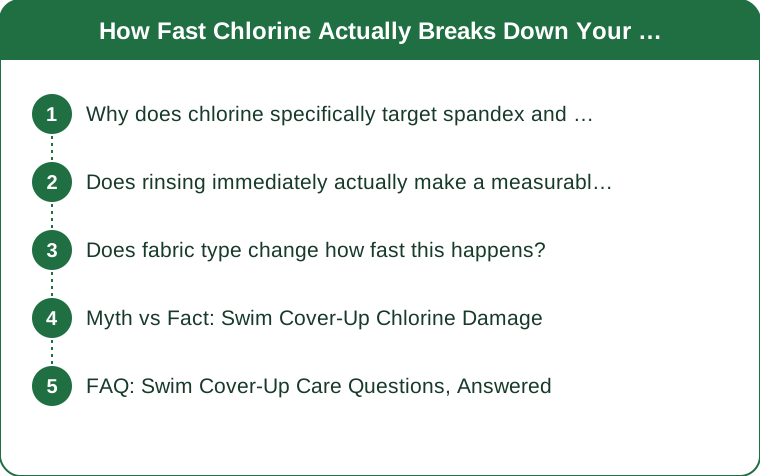
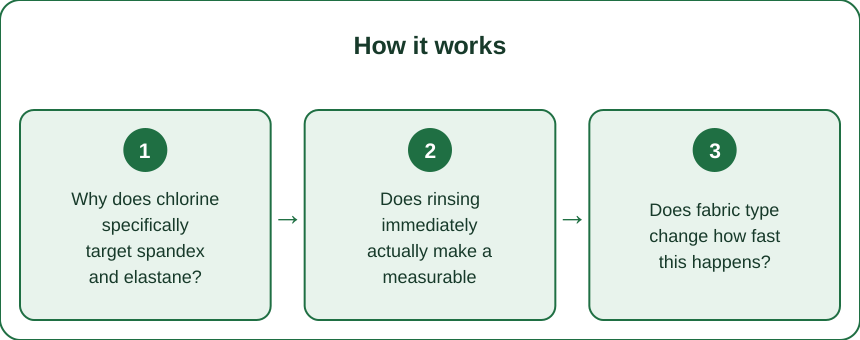
Why does chlorine specifically target spandex and elastane?
Chlorine is an oxidizing chemical that breaks down the molecular bonds in synthetic stretch fibers like spandex and elastane over repeated exposure. Each exposure without rinsing leaves trace chlorine residue on the fabric, which continues degrading fibers even after you’ve left the pool and the fabric has dried, compounding the damage over each subsequent swim.
Does rinsing immediately actually make a measurable difference?
Yes, significantly — rinsing a cover-up in fresh water within a few minutes of chlorine exposure removes much of the residual chlorine before it has time to continue breaking down fibers after drying. Cover-ups that get a prompt rinse after every pool day commonly last two to three times longer than ones that are left to air dry with chlorine still in the fabric.

Does fabric type change how fast this happens?
Fabrics with a higher percentage of pure polyester or nylon relative to spandex tend to resist chlorine damage better, since the damage concentrates on the stretch fibers specifically rather than the base fabric. A cover-up that’s 90% polyester and 10% spandex will generally outlast one that’s 50/50, even with identical exposure.
Myth vs Fact: Swim Cover-Up Chlorine Damage
Myth: Sun exposure is the main cause of swim cover-up fading. Fact: While UV contributes, chlorine residue left on fabric is often the larger factor in fiber breakdown and fit loss.
Myth: Air drying in the sun is fine as long as you don’t machine wash with chlorine on it. Fact: Chlorine residue keeps degrading fibers as it dries in the sun, regardless of whether it later goes through a wash.
Myth: All swimwear fabric degrades at the same rate. Fact: Higher-spandex blends degrade faster than higher-polyester or nylon blends under identical chlorine exposure.
FAQ: Swim Cover-Up Care Questions, Answered
Does a chlorine-resistant fabric label actually mean anything?
Yes, generally — fabrics marketed as chlorine-resistant use different fiber blends (often higher polyester content) that genuinely hold up longer under repeated chlorine exposure than standard swimwear blends.
Is a quick rinse as effective as a full wash after every pool day?
For most casual pool use, a quick fresh-water rinse covers the bulk of the benefit — a full wash with mild detergent every few wears adds extra protection without being needed every single time.
How can you tell fabric degradation has already started?
Look for slight thinning, a duller sheen compared to when new, or elastic that doesn’t snap back as firmly — these are early signs before visible holes or major stretching appear.
TL;DR:
- Chlorine breaks down spandex and elastane fibers starting from the first few exposures
- Rinsing promptly after swimming removes residual chlorine before it keeps degrading fabric while drying
- Higher-polyester blends resist chlorine damage better than high-spandex blends
- Sun exposure contributes to fading, but chlorine residue is often the bigger factor
Make the fresh-water rinse a habit right after you towel off — it’s a 30-second step that can meaningfully extend how long a favorite cover-up actually lasts.
Keep Reading
This article is for general informational and styling purposes only. Fit, sizing, and product availability may vary.
