How to Wear Your Swim Cover-Up After Swim Season Ends
Quick Answer: A cover-up is just a lightweight layer that has only ever been styled over swimwear — and lightweight layers are exactly what September dressing runs on. Shirt-style cover-ups convert directly into overshirts, kimonos and dusters become statement third pieces, tunics become tops, and crochet becomes texture layered over something opaque. The conversion rule is one sentence: replace the swimsuit underneath with an opaque base — a tank and leggings, a slip dress, a matching set — and the beach garment becomes a street layer. Terry robes and true sarongs mostly stay with the pool bag; everything else deserves an audition.
With end-of-season clearance racks full of them, this is also the cheapest layer category of the entire year. Here is the sorting system.

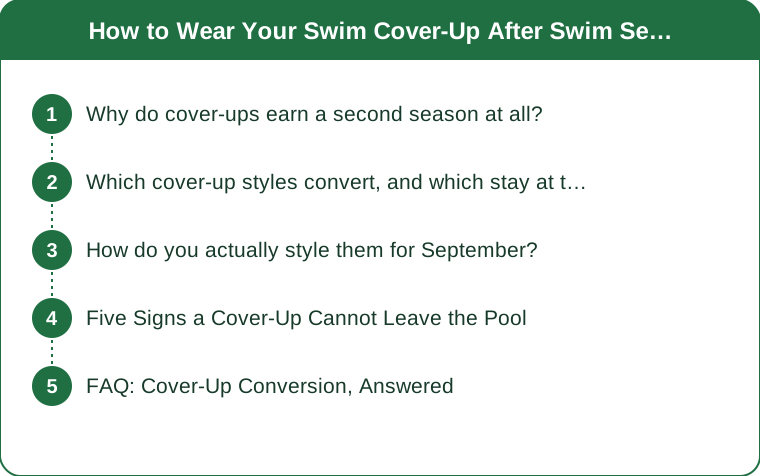
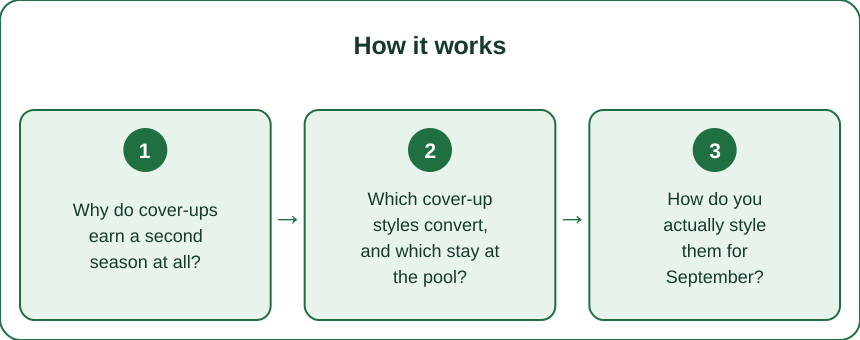
Why do cover-ups earn a second season at all?
Because the transitional wardrobe’s job description matches theirs exactly.
What September asks for is light, breathable layers that go on and off as the day swings twenty degrees — open fronts, easy volume, fabrics that pack small and shrug off wrinkles. That is a cover-up’s entire résumé. The category was engineered for throwing over, walking around in, and removing without ceremony; the only thing seasonal about it was what it was worn over.
The cost-per-wear math makes the same argument. A cover-up worn eight beach days a year amortizes slowly; the same piece pulling overshirt duty two mornings a week through September and October triples its wear count in one season. And since the category runs flowy, forgiving, and cut for easy movement, it converts into precisely the relaxed third pieces that are hardest to buy well at full price.
The objection is always sheerness — cover-ups are built to be worn over something, with open weaves and gauzy fabrics that read as beachwear because a swimsuit shows through. But that is a styling condition, not a flaw: worn over an opaque base, the same sheer layer reads as deliberate texture. The garment never announced beach. The bikini underneath did.
So the real question is not whether cover-ups can leave the pool. It is which constructions convert, and what goes underneath them when they do.
Which cover-up styles convert, and which stay at the pool?
Sort your pool bag into four converters and two lifers.
The shirt-style cover-up is the best converter in the category. An oversized button-front in cotton, linen, or crinkle gauze is literally an overshirt already — worn open over a tank and leggings or knotted at the waist over a slip dress, it carries zero beach signal. If you own one cover-up worth promoting, it is this.
Kimonos and dusters convert into statement third pieces. The long open silhouette layers beautifully over a simple monochrome column, adding movement and print. The single adjustment: anchor it with substance underneath — fitted base, real shoes — so the drama reads intentional rather than poolside.
Tunics convert into tops. A woven tunic over leggings is a classic fall formula waiting to happen; check opacity in daylight, and belt it if the volume swallows you.
Crochet and open-knit pieces convert as texture — layered over a long-sleeve tee or a slip in a matching tone, the holes become the point. Over bare skin they say August; over a base layer they say styled.
The lifers: terry and toweling robes (their fabric is a function, and the function is drying off) and true sarongs — though a great printed sarong has an honorable second life as a scarf or bag accent. Anything with drawstring-hood swim styling or boat-graphic energy also stays with the pool bag, happily.
One pass through the bag with these categories and most people find two or three legitimate new layers they already own.

How do you actually style them for September?
One formula, three variables — and the base does most of the work.
The formula: opaque column plus converted layer plus grounded shoes. Build a simple, fitted base in one color family — a tank with buttery-soft leggings, a matching set, a slip dress — then add the cover-up as the third piece, and finish with real shoes: sneakers, loafers, low boots. The fitted column gives the flowy layer something to contrast against, and the shoes are what finally overwrite the beach signal. Sandals keep it coastal; closed shoes make it September.
Variable one: proportion. Flowy layer, fitted base — the rule that makes every version work. If the cover-up is enormous, the base gets snugger; a voluminous kimono over wide-leg anything reads like bedding.
Variable two: structure on demand. Belting a shirt-style or tunic cover-up at the waist converts it from beachy to deliberate in one move, and gives shape on days you want definition rather than drift. A front knot does the same job at lower formality.
Variable three: palette temperature. Swim prints skew bright; September light rewards warmth. Convert the loud pieces by pairing them with cream, camel, olive, or black bases — one saturated layer against warm neutrals reads styled, while the same layer over more brights reads like the pool deck followed you home.
Temperature logic seals the argument: the open-front construction that ventilated an August boardwalk is exactly what a 62-degree morning that becomes a 78-degree afternoon requires. The cover-up was transitional outerwear all along — it was just moonlighting at the pool.
Five Signs a Cover-Up Cannot Leave the Pool
The fabric is terry, toweling, or anything that could dry a swimmer. Absorbency is beautiful function and unmistakable context — a terry robe over leggings reads as a spa walking tour, and no belt can save it.
Chlorine and sun have already written on it. Uneven fade lines, a stretched neckline, or that faint sunscreen-and-pool smell that survives washing means the piece served honorably and retires to actual pool duty. Clearance season is for replacing these, not promoting them.
It goes sheer the moment it stretches. Some knit cover-ups are opaque at rest and window-glass under any tension. Run the daylight stretch test before it leaves the house over leggings — the same test you would run on the leggings themselves.
The cut only makes sense over swimwear. Deep side slits to the hip, a plunge that assumes a bikini top, hems engineered to flutter at mid-thigh — construction that quotes the beach keeps saying beach regardless of the base underneath.
You cannot lift your arms without a reveal. The converted layer has to survive errands, reaching, and driving. If the whole silhouette relocates every time you flag a barista, it is a lounging garment — let it lounge poolside where it excels.
FAQ: Cover-Up Conversion, Answered
Should I wash them before promoting them to daily wear?
Yes, properly — chlorine, salt, and sunscreen residue keep degrading fibers in storage and carry that unmistakable pool-bag smell. A cold wash with a residue-fighting dose of detergent (no fabric softener on anything with stretch), fully air dried, resets the piece for its second season.
Is end-of-August clearance actually a smart time to buy them as layers?
It is the best layer arbitrage of the year — shirt-style cover-ups and kimonos at clearance prices are the same garments sold as overshirts and dusters at full price in other aisles. Buy with the September outfit in mind: neutral-friendly colors, opaque-enough fabric, sleeves you can layer.
What are the best base layers under converted cover-ups?
A fitted tank with high-waisted leggings is the universal answer; a matching set gives instant coherence under a printed layer; a slip dress plus sneakers takes the kimono version to dinner. The base’s job is opaque, fitted, and quiet — the layer is the interesting part.
Does the trick work in reverse — regular clothes as cover-ups?
Completely, and it solves next summer’s version of the problem: an oversized linen shirt or lightweight duster from your closet covers up beautifully, which means the best cover-up purchases are the ones that never specialized in the first place. Buy the two-season piece on purpose next time.
TL;DR:
- Cover-ups are lightweight open layers — the exact category September dressing runs on — and only the swimsuit underneath made them beachwear.
- Converters: shirt-styles (best), kimonos and dusters, tunics, and crochet over opaque bases. Lifers: terry, true sarongs, and anything cut to quote the beach.
- The formula: fitted opaque column, converted layer over it, closed shoes to overwrite the signal; belt for structure, warm neutrals to tame swim brights.
- Wash out the chlorine before promotion, and raid end-of-season clearance — it is the cheapest layer aisle of the year mislabeled as swim.
Before the pool bag goes to the closet shelf, lay every cover-up on the bed and sort them with the four-converter test. Most people walk away with two free layers and a shorter fall shopping list — ten minutes, zero dollars.
See It in Motion
Seen here: High Waist Yoga Leggings with Side Pockets — shop it on bubblelime.com
Keep Reading
This article is for general informational and styling purposes only. Fit, sizing, and product availability may vary.
